Robbins TBM completes ‘record’ run on tunnel project

25 March 2022
A Robbins Single Shield Tunnel Boring Machine (TBM) has completed a record-setting 3.5km run in sedimentary rock below Lake Ontario for the Ashbridges Bay Outfall in Toronto, Ontario, Canada.
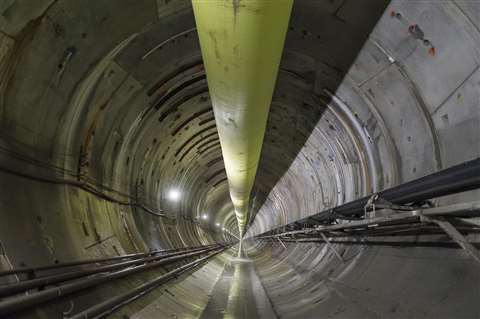 The project won accolades from the Tunnelling Association of Canada (TAC) in late 2021 for its all-remote machine acceptance enacted due to the Covid-19 pandemic, said Robbins (Photo: Robbins)
The machine project, for the Southland/Astaldi JV, began in March 2021 at 85m deep and 16m diametre shaft, boring initially into predominantly shale - with limestone, siltstone, and sandstone.
The completed outfall will connect to the 50 in-lake risers to enable efficient dispersion of treated effluent over a wide area of the lake. The project, for the City of Toronto, was completed with the aim to improve the city’s shoreline and Lake Ontario’s water quality by replacing existing outfall.
Alfredo Garrido of Robbins Field Service, said, “This is a wonderful type of geology for our machines. During the entire excavation, a total of 7 cutters were changed. The wear behaviour is incredible, between 2 and 5 mm, and everyone is amazed by the cutter performance.”
A Robbins continuous conveyor system, including a vertical conveyor, transported muck behind the machine. “Every 25 machine cycles, it was necessary to stop the excavation to probe drill hole in front of the cutterhead to check for possible water. This drilling was done basically every day, stopping the machine for a few hours, but it was very necessary,” added Garrido.