US army contract for Broshuis equipment trailers

28 September 2022
USA-based Oshkosh Defense has been awarded a defense contract to produce enhanced heavy equipment transporter systems (EHETS) trailer for the US army.
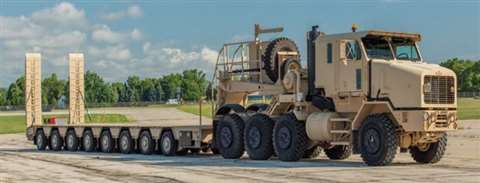 The new contract will produce almost 500 trailers for the US army (Photo: Oshkosh Defense)
Oshkosh will execute the contract with the support of its major subcontractor, Dutch specialized transport company Broshuis.
The five-year requirements contract is valued at $263.2 million for an estimated 466 trailers and associated logistics products and support services.
Under the first delivery order, valued at $37.6 million, Oshkosh Defense will produce five test trailers for product verification testing (PVT), operational testing (OT), logistics development and engineering development, along with 68 production trailers.
Self-loading trailers
Oshkosh Defense designed the EHETS trailer to be pulled by the Oshkosh Heavy Equipment Transporter (HET) A1 currently in service with the US army.
The combined HET A1 and EHETS trailer system is designed to self-load and unload and can haul a payload of up to 90 tons (81.6 tonnes), allowing it to transport the heaviest army tracked vehicles, including current and future versions of main battle tanks (MBTs), while also obtaining European road permissions at required payloads.
Pat Williams, VP and general manager of US army and US marine corps programs for Oshkosh Defense said the company will, “develop and deliver vehicles and trailers specifically designed to meet stringent military requirements and survive the rigors of modern combat.”
He said, “The EHETS trailer is one such example of our commitment to meeting our customer’s mission requirements. We are proud that the US army has once again called on us to produce another mission-critical trailer.”.