JCB’s hydrogen-powered speed record bid

14 May 2026
JCB, which currently holds the world land speed record for a diesel-powered car, is bidding to break the speed record again – this time with a car powered by hydrogen.
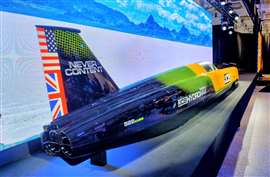 JCB’s new HydroMax car
The company set the diesel-powered land speed record at the Bonneville Salt Flats in the United States in 2006.
Twenty years on, the same driver, former RAF wing commander Andy Green, OBE, will be behind the wheel for the hydrogen-powered attempt – at the tender age of 63.
The bid was announced on Tuesday, by JCB chairman Lord Anthony Bamford, at a press event at JCB’s world headquarters in Rocester, UK.
When asked why he planned to go back to Utah with an all-new hydrogen-powered car, his response was “Why not?” He then described the importance of hydrogen for the future of construction equipment and potentially the British economy.
He said he hoped the record attempt by the JCB Hydromax car would be inspirational, in the way that he was inspired by the Apollo 11 launch in 1969. “And what fuel were they using?” he asked. “Hydrogen”.
The Hydromax is powered by two four-cylinder hydrogen internal combustion engines, totalling 800hp.
Andy Green said the new car was more aerodynamic and more powerful than the Dieselmax he drove in 2006, adding that he would be “amazed” if it didn’t surpass the 350mph record achieved by the diesel-powered version.
3CX Hydrogen backhoe ‘market ready’
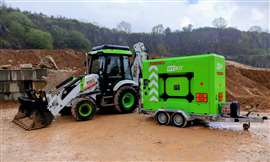 The JCB 3CX Hydrogen backhoe loader, with a HYKIT hydrogen refuelling unit
The speed record attempt launch followed the company’s launch to market of its latest production-ready hydrogen-powered backhoe loader, the 3CX Hydrogen.
The loader has a 55kW hydrogen engine, which boasts the same power and torque as its diesel equivalent.
Currently, 500-hour service intervals also match the diesel versions, although JCB engineers at the launch were quietly confident that these intervals would expand, due to the less damaging effects on the engine of the clean-burning fuel.
JCB’s application and training manager for backhoe loaders, Georgina Williams, said, “Because this hydrogen engine is a true drop-in replacement, we’ve been able to retain the existing powertrain architecture of the 3CX; the same axles, the same transmission, the same hydraulics, so this machine can be used, supported and serviced anywhere in the world, exactly as a 3CX is today.”
Fuel for the new machine is stored in tanks above the cab at 350 bar, before it’s regulated down to 20 bar, as it flows down to the engine.
The ground-level filling point gives easy access for refuelling, which takes just a few minutes.
At the launch, a mobile hydrogen fuel system called HYKIT was used to demonstrate the refuelling process. The company says one trailer-mounted unit can charge a fully operational 3CX hydrogen backhoe for around a week’s work.