Beyond the logo: Why content is the engine of successful B2B brand transformation
28 July 2026
When businesses embark on a brand transformation, the conversation almost always begins with a new name, a new logo and a refreshed visual identity.
In my experience, that’s also where many companies get it wrong.
A new identity signals change. It doesn’t, on its own, create understanding.
For B2B companies, the success of a brand transformation isn’t determined by what happens on launch day. It’s determined by what customers, partners and employees believe in the months before and after it.
This is particularly true in specialist sectors such as construction, power, transport, manufacturing and industrial technology, where purchasing decisions are complex, relationships are long-standing and trust has often been built over many years.
I’ve lost count of the number of times I’ve seen businesses invest enormous amounts of time and money into a launch event, only to underestimate the importance of the communication that surrounds it. Yet that communication is often what determines whether a new brand is embraced or simply announced.
 KHL Content Studio Director, Jon Abrahams
When a new brand is introduced, customers naturally begin asking questions. What has changed? Why has the business changed? Will products and services remain the same? Can I still trust this company? What does this new business stand for, and what does it mean for me?
These are entirely reasonable questions. Yet they cannot be answered by a new logo, a redesigned website or a launch event alone.
They are answered through communication over time.
More specifically, they are answered through strategic, consistent and credible content that helps audiences understand not just what has changed, but why it matters.
In fact, I believe the most successful brand transformations often begin long before the new identity is revealed.
Businesses that begin explaining why change is happening before they announce what has changed remove uncertainty from the process. By the time the new name or logo appears, customers already understand the strategic direction. The visual identity becomes the culmination of the journey rather than the start of it.
B2B brands are built differently
Unlike consumer brands, B2B companies operate within markets where purchasing decisions are rarely impulsive. Buying cycles are long, investments are significant and decisions are made collectively by engineers, procurement specialists, technical experts and senior leadership teams.
Each stakeholder evaluates a business differently. Engineers seek technical credibility. Procurement teams focus on commercial value. Executives consider long-term stability, innovation and strategic direction.
When a company transforms its brand, every one of those audiences needs reassurance.
The challenge isn’t simply making people aware of a new identity. It’s helping them understand the business behind it.
Successful B2B brand transformation is therefore less about promotion and more about education.
Content builds belief
A branding agency can create an outstanding visual identity, define messaging and deliver a compelling launch campaign.
Content is what brings that brand to life.
Thought leadership demonstrates expertise. Customer success stories provide proof that strategic ambitions are being delivered in practice. Executive interviews allow leaders to explain vision and purpose, while technical articles educate engineers and specifiers. Research reports establish authority, and webinars and podcasts create opportunities for discussion rather than one-way communication.
Collectively, these activities answer the questions customers are already asking. Over time they replace uncertainty with understanding, and understanding with confidence.
Brands don’t change when logos change. Brands change when perceptions change.
That shift in perception rarely happens overnight. It develops through repeated exposure to valuable information that consistently reinforces what the business stands for, where it is heading and why customers should believe in that journey.
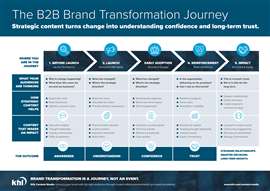 Click on the image to download the Brand Transformation Journey infographic as a PDF
Why trusted editorial media matters
B2B buyers don’t simply consume marketing—they conduct research.
They compare suppliers. They seek recommendations from peers. They read independent publications, attend webinars, listen to industry experts and evaluate evidence before making significant purchasing decisions.
During a brand transformation, that research becomes even more important because buyers are trying to understand not only what has changed, but whether they should continue to place their trust in the company.
That is why trusted editorial media plays such an important role.
Editorial credibility creates an environment where businesses can share valuable thought leadership rather than simply broadcast corporate messages. It provides context, relevance and trust—qualities that become especially valuable during periods of organizational change.
Reaching the audiences that matter
Launching a successful B2B brand isn’t about reaching the largest possible audience.
It’s about reaching the right audience.
Whether introducing a new business, repositioning an existing company or entering a new market, success depends on engaging the people who influence purchasing decisions.
Access to highly engaged specialist audiences is therefore every bit as important as the quality of the content itself. Creating compelling stories is only part of the challenge. Ensuring those stories reach engineers, OEMs, contractors, fleet operators, consultants, procurement specialists and senior decision-makers is what ultimately drives awareness, understanding and long-term adoption.
Brand transformation is a program, not a campaign
One of the biggest mistakes I see companies make is treating a rebrand as a campaign measured in weeks.
Successful B2B brand transformations are communications programs measured in months.
Launch day matters, but it is only one milestone within a much longer journey.
The months before launch provide an opportunity to explain the strategic direction, educate audiences and prepare the market for change. The months afterwards reinforce that narrative through executive insights, customer stories, industry commentary, technical education and thought leadership.
Every article, interview, webinar, podcast and customer story becomes another opportunity to reinforce the same strategic message.
Consistency, not volume, is what changes perception over time.
This sustained approach transforms a launch event into an ongoing program that builds familiarity, confidence and trust.
Beyond the brand
A successful B2B brand transformation is never simply about changing how a company looks.
It is about changing how a company is understood.
I’ve come to see the relationship as remarkably simple.
Branding creates recognition.
Content creates understanding.
Understanding builds confidence.
Confidence builds trust.
And trust is what ultimately drives long-term commercial success.
The strongest B2B brands aren’t remembered because they launched successfully.
They’re remembered because they took the market with them.
A new logo may capture attention. A compelling narrative, communicated consistently through trusted content, is what earns understanding.
In my view, that’s the real measure of a successful brand transformation.
The companies that leave a lasting impression aren’t those with the biggest launch event. They’re the ones whose customers understood the story behind the new brand before it was unveiled and continued to believe in it long afterwards.
Because in B2B, brands aren’t built when the logo changes.
They’re built when people change what they believe.
Supporting documents
Click links below to download and view individual files.