Cummins launches e-compressor for fuel cell engines

27 March 2024
Cummins Engine Components (CEC) launched its first E-compressor for fuel cell engine in Wuxi, China on Feb. 1, 2024. The company described the launch as a new milestone for Cummins Turbo Technologies and a big step forward in Cummins Inc.’s Destination Zero strategy for reducing carbon and other emissions.
 The Cummins e-compressor is applicable for 150- to 200-kW fuel cell engines and 240- to 260-kW fuel cell engines under turbine energy recovery. (Photo: Cummins)
Key characteristics of the e-compressor are low noise, high speed and high efficiency, said CEC. The e-compressor uses a 45-kW high-speed motor with the maximum design speed of 110,000 rpm. It is applicable for 150- to 200-kW fuel cell engines and 240- to 260-kW fuel cell engines under turbine energy recovery.
Additional features include:
- Low-inertia rotor design due to a high-pressure ratio design that keeps the package as small as possible. It enables faster startup and an improvement in acceleration performance, the company noted.
- Full-blade impeller design offering the potential to lower the frequency of blade pass noise to within safer limits in noise reduction.
- High-efficiency aerodynamic design that utilizes less energy and improves fuel economy.
- Low-thrust loading wheel design optimizes the two-side impeller sizing to balance thrust load without performance trade off. It is designed to deliver smoother rotation and higher reliability.
- Robust containment design provides larger design margins from containment testing and improves product safety during the running condition.
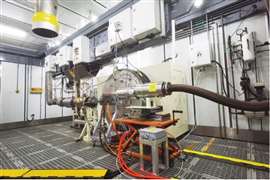 A test cell has been upgraded for testing the new e-compressors. (Photo: Cummins)
Alongside the e-compressor launch, CEC announced that a test cell has been upgraded with dual phase controllable power supply, coolant system and optimized pipeline connections to enable improved testing of performance and endurance capability for E-compressors.
Cummins is scheduled to establish e-turbo testing capabilities later this year as part of a Phase II upgrade for this test cell, facilitating rapid validation and product iteration for its e-turbo offerings. A separate air-cooling system will be implemented to expand the controllable range of airflow and enhance the turbine inlet system.