Electric vehicle lift from Versalift
05 April 2019
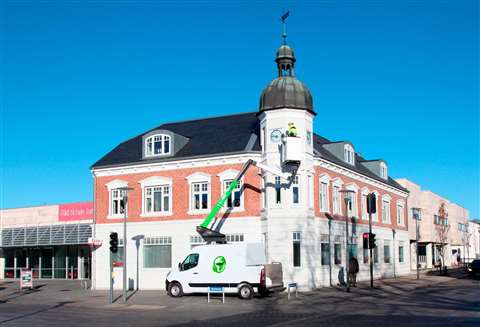
Versalift has provided further information about the 100% electric vehicle lift it will show at Bauma.
The manufacturer’s VTL-120 platform is mounted on a fully-electric Renault Master and has a working height of 11.7m and a basket capacity of 120kg. The vehicle will have a range of 100km, even loaded to its maximum capacity. The unit has a payload of 185kg, including driver and passenger.
The 100% electric lift is powered by a Lithium-ion battery and is available with either small, 2.5 kWh or big, 5 kWh, power pack. The small battery can perform 20-30 cycles, while the larger can provide 40-60 cycles.
Versalift can also offer the 100% electric lift with either a VDTL-38-140 or VTL-37-135 mounted on the Renault Master.
The company will also show the dual-telescopic VDTL-155 mounted on Ford Ranger. The VDTL-155 has a working height of 15.5m and has a platform height of 13.5m. The cage load amounts to 120kg/230kg, while horizontal reach is 7.5m/5.6m.
On the stand too, is the VTM-150-F, mounted on a Mercedes-Benz Sprinter and has a cage load of 120kg/265kg and a horizontal outreach of 9.4m/7.5m. Working height is 14.9m. GVW is 5000kg and payload is 990kg.
The VTX 240 mounted on the Mercedes-Benz Sprinter is also featured at Bauma. The VTX 240 has a working height of 24.2m and a maximum outreach of 12.3m. The VTX-240 has the capability to go up and over buildings.
Lastly, the LT-23-90-TB, mounted on a Fiat Doblo, will round off the manufacturer’s stand offerings. The LT-23-90-TB is mounted on the compact and light Fiat Doblo Workup.