Horizon consortium wins €352m contract on Toulouse metro

23 March 2023
Mass transportation system operator Tisséo has awarded a €352 million contract to the Horizon consortium to deliver a significant element of the expanded Toulouse metro.
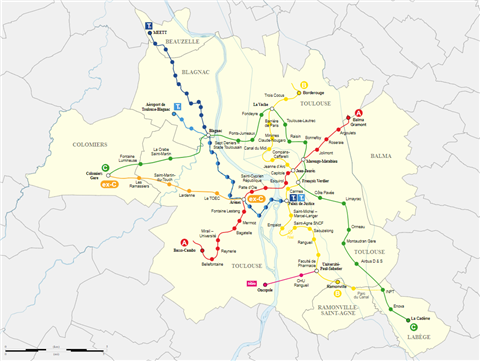 Toulouse metro map, with the future line C shown in green. Image: Sémhur / Wikimedia Commons
The Horizon venture is led by French contractor Bouygues Travaux Publics (65%) and includes foundations and tunnelling specialists Bessac, Soltenache Bachy France and Soltenache Bachy Tunnels (35%).
The consortium will undertake engineering work on batch 4 of the future line C of the metro, with the scope of work including the construction of two tunnels and four stations.
A TBM will be used to construct a 4,160m-long tunnel, with an internal diameter of 8.5m.
A 650m-long tunnel will also be built, using the cut-and-cover method.
As well as the construction of stations at Montaudran, L’Ormeau, Limayrac-Cité de l’Espace and Jean Rieux, the consortium is charged with delivering three ancillary structures and galleries, which will connect Montaudran to the shorter tunnel.
In a statement, Bouygues said of the project, “In addition to the complexity inherent in underground works, the main challenges of this project, which is being carried out on an urban site, are the phased construction of the end cut-and-cover tunnel through which the TBM must start digging and an interface with the viaduct construction site at the end of the tunnel at Montaudran.”
The group says its environmental commitment will see it preserve trees wherever possible, as well as sorting, removing and processing excavated material for reuse via local recycling channels.