Magni assist for wind energy pioneer
27 October 2020
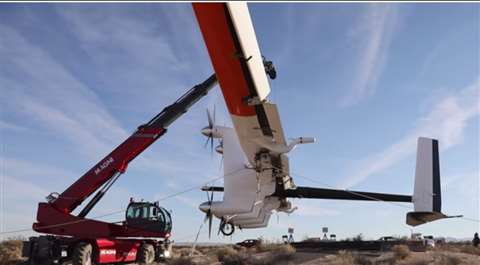
Italian equipment manufacturer Magni Telescopic Handlers has revealed how its RTH 6.35 rotating telescopic handler model was used to assist in the development of a new renewable energy technology.
For the past 13 years, US-based company Makani Power has been actively developing an airborne system to make harnessing wind energy more accessible and cost-effective than traditional wind turbines.
Makani Power used Magni’s RTH 6.35 handler model to move and suspended an experimental airborne wind turbine, known as an energy kite.
The handler has a lifting capacity of 6,000kg and can rotate a full 360 degrees. It has a maximum working height of 34.9m and a reach of 27m.
In the testing of the energy kite, the RTH 6.35 model was used with various attachments including a platform, winch and fork carriage.
A specially designed attachment was also created for the project, which according to Makani, resulted in the world’s first offshore flight of an airborne wind turbine.
Magni said, “It was a very heartfelt collaboration, first of all because Magni has always been devoted to seeking and supporting sustainable solutions and secondly because new ideas are the forge that feeds the passion of our Team.”
While the development of Makani’s energy kite has now come to an end due to lack of investment, the project has become the subject of a US documentary.