New electric telescopic crawler crane from Sany

07 October 2022
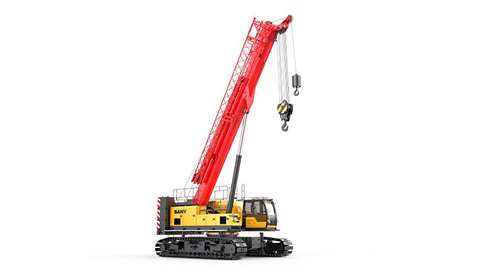 Sany SCE800TB-EV battery-electric crawler crane. Image: Sany
Chinese crane and construction equipment manufacturer Sany has launched an electrically powered telescopic boom crawler crane.
The 80 tonne capacity SCE800TB-EV has a five-section 47 metre boom and a maximum load moment of 300 tone-metres. There is a 7.2 metre swing away jib and fixed jib options are 10.2 metres and a maximum of 17.5 metres. With the boom fully extended at 47 metres and 26 tonnes of rear counterweight charts shows a capacity of 11 tonnes at 11 metres radius.
Power is from a 282 kW-h lithium iron phosphate (LFP) battery pack. Fast charging can be done with one or two 200 Amp inputs. A normal slow charge is via a 63 Amp mains supply.
Motive power
A 600 Volt DC permanent magnet main drive motor from Danfoss, rated at 206 kW, runs the hydraulics. It has a maximum torque rating of 1,310 Newton-metres. Like the battery pack it is liquid-cooled.
Maximum transport width for components is 3 metres and it has loads charts for use with reduced counterweight. Maximum rear counterweight is 26 tonnes and there are two 3 tonne blocks of car body counterweight. It has hydraulically retractable crawler frames and the cast steel track pads are 850 mm wide.
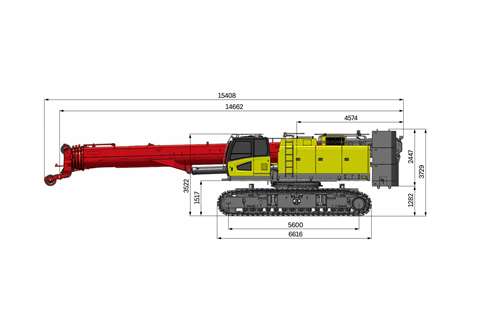 Basic dimensions of the 80 tonne capacity Sany SCE800TB-EV. Image: Sany