Emissions-free turbine blade installation
18 December 2019
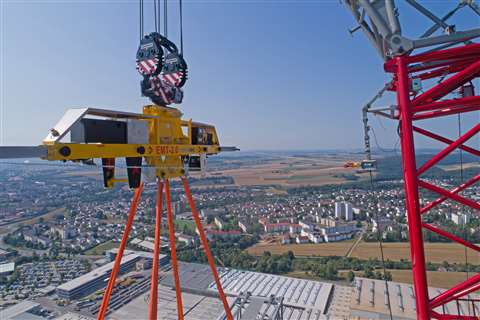
Memmingerberg, Germany-based engineering specialist Ematec has announced that its RBT, RBC and EMT wind turbine rotor blade lifters are now available as electric versions. They utilise the company’s GreenLine battery drive.
The GreenLine’s electric motor is under 48 volts, which Emertec said means it complies with regulations in the USA and meets the requirements of global safety certification company Underwriters Laboratories.
The electric drive operates in silence and provides over 16 hours of working time in temperatures as low as -20 degrees, the company said. According to Emertec, this means it can install up to three rotor blades in one day.
The battery takes 2.5 hours to recharge, using an integrated charger. Emertec explained that its GreenLine battery drive system’s efficiency is due to it only being active when movements on the rotor blade lifter are required. The remainder of the time it is in sleep mode.
“It is just a perfect match: an emissions-free rotor blade installation for regenerative energy,” said Manfred Eberhard, Ematec CEO. “There is enormous potential. We are offering an ecological solution that can save wind turbine manufacturers a lot of trouble in complying with the various emission regulations - whether in China, the EU or the USA.”