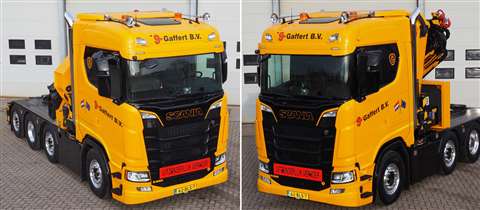
Customised Scania tractor with crane
25 July 2019
Dutch horizontal and vertical transport specialist Gaffert is operating an extra-short Scania S 520 8×2/*6 tractor with an 85 tonne-metre crane mounted on it.
It is a four-axle truck, with three of the axles being steered to aid manoeuvres in tight industrial environments. In addition, its compact size also helps it run under 72-tonne road transport weight limits. The truck wheelbase is 3,950 millimetres, measured from the front axle to the driven axle.
Gaffert wanted a heavy tractor unit with a crane mounted on it that could drive at normal road speeds and provide good weight distribution. “By using a 10 tonne front axle we have a beautiful weight distribution with the crane placed very close to the cab wall,” said Gaffert owner Theo Gaffert. “There are only 15 centimetres left between the cabin and crane, which we use for the hydraulic tank.”
The truck’s short configuration meant that placing all the components on the chassis was challenging. “To obtain the best result, we designed some of the components ourselves, such as the custom-built fuel tank and our own mudguards,” explained Gaffert. “The combination of a short turning radius with great lifting capacity makes this truck extremely suitable for working in industrial buildings. We are often called on to help lift new machines and hoist equipment into place.”