Jet’s latest blasting techniques keep dam walls stable

02 May 2022
New blasting techniques have been developed specifically to retain the structural stability of dams themselves, with no wasted effort. These projects call for highly controlled, cautious, partial demolition techniques.
South African contractor Jet Demolition’s work on large water-retaining dams is among the most important projects the specialist contractor has undertaken to date.
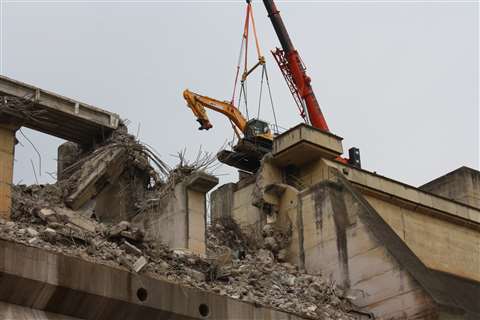 Jet Demolition compiled specific demolition control techniques for the Hazelmere Dam project in South Africa. (Photo: Jet Demolition)
Rehabilitation of dam walls usually requires demolition of redundant portions of monolithic blocks and associated concrete structures.
Dynamic energy imparted by the demolition process has the potential to cause damage to concrete located just across the demolition boundaries and beyond.
While it is essential to avoid damage to remaining concrete, it is also important to carry out the demolition works in a productive and cost-effective manner.
“Our work at Hazelmere Dam allowed for the compilation of specific demolition-control guidelines to be developed for dam rehabilitation projects,” said Jet’s contracts manager Kate Bester.
Located on the Mdloti River in KwaZulu-Natal, the Hazelmere Dam was built in the 1970s. It was designed originally to accept radial arm gates to raise the full supply level.
However, a subsequent redesign showed this would be achieved optimally via a piano key weir.
To clear the way for new construction works, demolition of the existing spillway crest, piers, lintel beam, and bridge decks required the controlled removal of 5,300 cubic metres (187,000 cu ft) of concrete up to 3 m (10 ft) thick.
The key requirements were to demolish the redundant structures in a safe, rapid, cost-effective, and controlled manner, without residual damage.
“Our production blasting programme and demolition methods achieved all of these objectives successfully,” adds Kate Bester.