GPEC in Hong Kong-Zhuhai-Macau Bridge build
02 April 2014

Engineering company, Guangdong Lift Engineering Machinery (GPEC), based in China, used S2.34 self propelled modular transporter (SPMT) from Tianjie to help finish the construction of Asia's Hong Kong-Zhuhai-Macau Bridge.
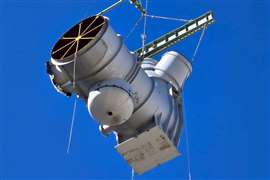
The bridge is being built in Zhongshan, Guangdong Province. GPEC transported a steel bridge section weighing approximately 1,650 tonnes and measuring 33.1 metres long and 4.5 m high into position.
A team from GPEC and two engineers from Tianjie used four sets of S2.43 SPMT combination to transport the 1,650 tonnes of steel. Each section of the transport had one 390 kW power pack unit, two 6-axle self propelled modules and one 4-axle self propelled module, a company spokesperson said. In total 64 axles were used.
To make sure the transport remain stable, the four power pack units were connected and controlled by one remote control, a spokesperson added.
Rubo Liang, GPEC project manager, said, “SPMT has now gradually been used in many oversized and overweight transportation. Every self propelled module can be combined both lengthways and breadthways, so it is easy for us to assemble and disassemble the vehicle. Tianjie has been a cooperative partner and trustful for GPEC for many years. I believe both SPMT and Tianjie will have a bright future.”