Hüffermann launches electric assembly crane
06 March 2015
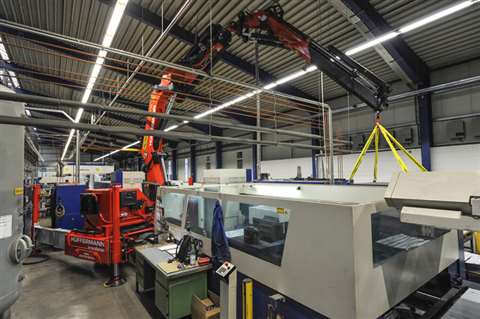
Lifting specialist Hüffermann from Wildeshausen in Germany has launched a new electric assembly crane.
The model consists of a Palfinger PK 53002-SH articulating hydraulic loader crane fitted on a chassis designed by Hüffermann. Both the chassis and the crane are powered by a traction battery or via a mains power cable.
The crane has a maximum reach of 23 m and a 1.2 metre high support system. The electrically driven crane has a capacity of 10.2 tonnes at 4 m and lifts 2.5 tonnes when working at 16 m radius. It is designed to work in sensitive areas and, therefore, produces no noise or exhaust gas emissions.
All-wheel steering is incorporated for maximum manoevrability in confined spoaces. With a length of 5.6 m and a width of 1.9 m, it is suitable for working in narrow spaces. In addition, it has a turning radius of less than 3.9 m. The axles can be controlled individually and it is fitted with variable extendable outriggers. The front supporting carrier is moveable by 800 mm and the maximum support base is 5.6 x 6.6 m.
The electric crane can work in places where extension rails and forklift trucks cannot work, for example, under overhead tracks when exchanging plant components and conveyor technology, the manufacturer added.