Schuch orders 15 Liebherr cranes

18 January 2022
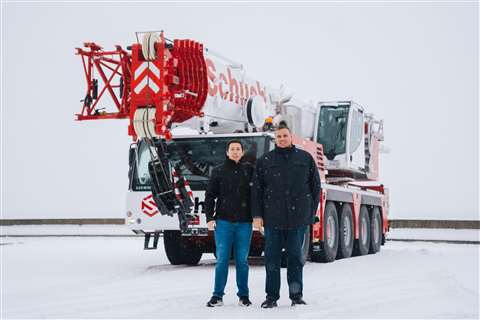 First of the 15-unit order was a 150 tonne capacity LTM 1150-5.3, handed over at the Ehingen factory in Germany. Tim Schuch is on the left with his father Stefan
German crane rental and heavy haulage specialist Schuch has ordered 15 new Liebherr wheeled mobile telescopic cranes, the first of which has been delivered.
Capacities of the new units will range from 90 to 750 tonnes. Some will expand the 80-strong fleet while others will update it by replacing older models. Deliveries of the first units have been made and will continue until the end of 2023.
Schuch operates ten depots in the Rhine-Main and Rhine-Neckar areas between Saarbrücken, Frankfurt and Karlsruhe. It reported a full order book of rental work as a result of projects to expand rail, road and renewable energy infrastructure. Stefan Schuch, managing director, explains, “Expanding the infrastructure for rail, road and renewables requires more mobile cranes. That is what made up our minds to expand our fleet.”
Stefan’s son Tim, also a managing director at the third generation family-run company, said, “It is important to keep our crane fleet up with the very latest crane technology to ensure that we can provide our customers with the best possible service. That is another reason for investing in new mobile cranes.”
Schuch has been buying Liebherrs for 35 years. A benefit of having multiple cranes from one manufacturer is that the crane control systems are uniform on all Liebherr mobile cranes, from small to large, Tim Schuch said.