Turkey and Iraq unveil plans for US$17 billion Development Road project

05 January 2024
Turkey’s foreign minister Hakan Fidan has unveiled the Development Road Project, the $17 billion initiative aimed at bolstering connectivity between Turkey and Iraq.
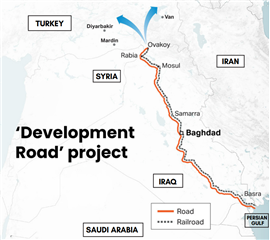 Map showing the proposed route of the road and rail link between Iraq and Turkey
Fidan said the project, spanning 1,200km (745 miles), will primarily involve Turkey and Iraq, with Turkey hosting nearly a tenth of the infrastructure.
A significant link between Asia and Europe, the project is set to establish a network of railways and highways, linking the Grand Faw Port in southern Iraq to Turkey’s border and further extending into Europe.
Wide range of construction activities
In a statement to the media, Fidan said one of the project’s focal points would be the construction of a major port in the city of al-Faw. He stressed the strategic importance of the Persian Gulf port, which he said would play a pivotal role in enhancing logistical connectivity in the region.
He also highlighted the development of roadways, railways, natural gas and oil pipelines, as well as the potential integration of fibre optics.
“We believe that regional development projects are extremely important; that is, the only thing that will increase the vision of the region, the quality of life and the depth of cooperation is the implementation of such projects and joint projects,” Fidan said.