Volvo launches new compact excavator
02 November 2020
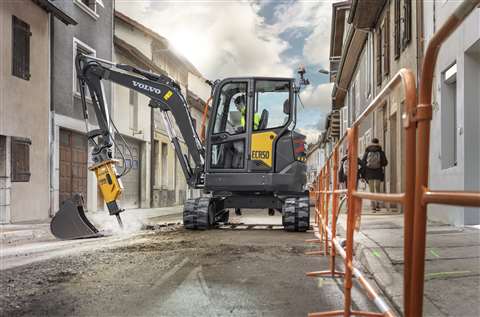
Swedish OEM Volvo Construction Equipment (Volvo CE) has launched a new 5 tonne zero tail-swing compact excavator.
The company says the ECR50 combines ease of operation and the ability to operate in confined spaces with enhanced durability.
The overall width of the machine is 2,000mm; the overall length is 5,198mm.
The excavator’s engine has a gross power of 31.2 kW at 2,200 r/min, and an operating weight of 5,050kg.
The ECR50’s manoeuvrability and tight turning radius is aided, says Volvo, by an in-track boom swing, which ensures the swing post and cylinder remain within the track width when digging alongside obstacles.
This could benefit rental companies, keen to incorporate equipment that can be kept as free from damage as possible.
Another feature that could make the ECR50 attractive to rental companies is the reinforcement of its digging equipment, undercarriage and hoods, giving it greater durability.
Volvo has amended the layout of the F generation machine’s controls, with a simplified layout for operators, including what the company calls an “automotive style” jog wheel, 125mm colour display and proportional fingertip controls.
The company says additional benefits for operators include large travel pedals and automatic two-speed travel. A hydraulic quick coupler and step-by-step on-screen instructions also simplifies the job of changing attachments.
Extras on the ECR50 include a tilt quick coupler, extra counterweight and seatbelt warning beacon.
The excavator is, according to Volvo, more than 93% recyclable and also compatible with bio hydraulic oils.