Sabrex is a cut above
12 December 2018
The capability of an explosive cutting tool has been dramatically demonstrated during the sinking of a Portuguese naval warship to create an artificial reef.
The corvette Afonso Cerqueira, which was retired from service in 2015, was sunk 450 m (just over a quarter of a mile) off the coast of Madeira.
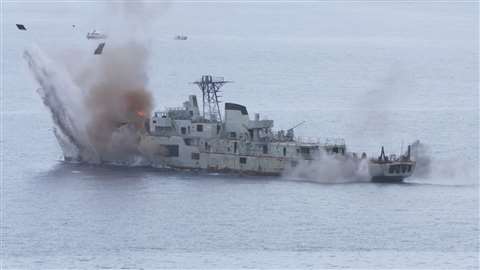
Sabrex, an explosive cutting charge, was used to cut 16 holes – each measuring 1 sq m (10.7 sq ft) – out of the ship’s hull under the waterline. The ship sank in less than two minutes.
“We needed to rapidly and very precisely cut holes big enough to allow in the water, but without weakening or damaging any of the superstructure,” said Chris Smith of Chemring Energetics UK (CEUK) which manufactures Sabrex.
“The idea is for the ship to remain intact and upright to help improve biodiversity and develop underwater tourism.”
The company worked closely with the regional government of Madeira, the Portuguese Navy and contractors Tecnovia Madeira on the project.
The manufacturer said Sabrex can be used in depths of 12 m (39 ft) with no adverse effect on its performance and has been used to sever 25 mm (1 in) of steel plate at a depth of 25 m (82 ft). It is supplied in lengths of 4 m (13 ft) in six different sizes.
The specialist explosive used on the Afonso Cerqueira, which will become a haven for marine wildlife as well as a destination for diving enthusiasts, was put in place by a team of Portuguese Navy Explosive Ordnance Disposal divers. They first used Sabrex two years ago when another corvette – the General Pereira d’Eça – was sunk to form another artificial reef.