HKL helps in tight conditions
27 June 2019
German rental company HKL has supplied specialised equipment to contractor VSTR AG Rodewisch, which is responsible for installing the pipelines for a large residential development in the northeast of the German capital, Berlin.
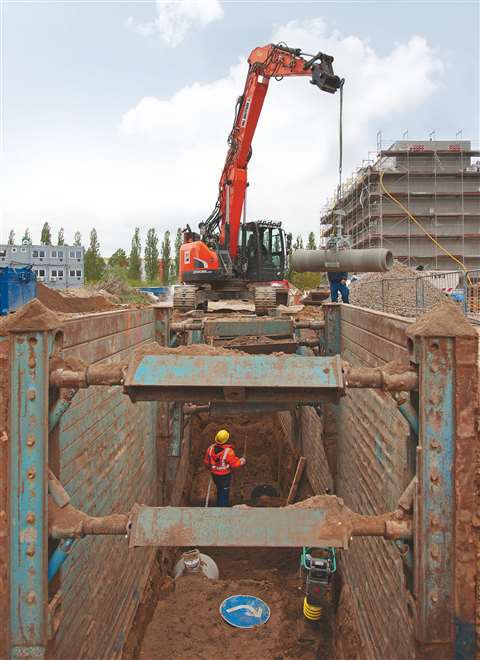
For the Mein Falkenberg project, about 1,240 residential units will be built on an area of 130,000m2 by 2022. However, the project is characterised by narrow spaces and tight schedules, so VSTR relied on HKL to provide specially equipped machines.
Among them was a 22 tonne Doosan DX235 crawler excavator that was fitted with a hydraulic quick-change system to enable attachments to be replaced remotely from the driver’s cab. This was said to save a lot of time since the spoon and gripper are changed several times an hour. The pipe gripper, with particularly small dimensions, was also ordered separately for the project to make it possible to insert the solid wastewater pipes into the narrow excavation pits.
A ViO50 short-tail excavator from Yanmar, an Atlas 160 W wheeled excavator and a Kramer 880 wheeled loader were also supplied to navigate the confined spaces on site while still offering good power.
Andreas Schober, Polisher of VSTR AG Rodewisch, said of HKL, “Thanks to the long-standing and trusted cooperation, we can speak openly about what we need and where we see difficulties.”