SC&RA Job of the Year Awards: the eight winning jobs

18 May 2026
American Cranes & Transport and International Cranes and Specialized Transport exclusivelly present the SC&RA Job of the Year Award winners. Eight jobs in the categories of rigging, hauling and moving won the prestigious awards.
Pressing matters
Handling components weighing up to 340,000 pounds (154 tonnes) within a constrained indoor environment, PSC Crane & Rigging completed the installation of a Sacmi PHL16000 hydraulic press at WCR’s facility in Xenia, Ohio, USA. The project required unloading, internal transport, uprighting and final assembly of the press system, all performed inside an active manufacturing building with limited floor space and restricted overhead clearance.
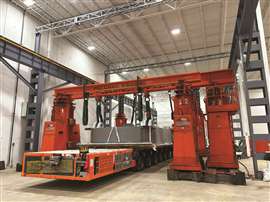 PSC Crane & Rigging used a complex gantry and SPMT system to install a hydraulic press. Category: Rigging Under $300,000
At the center of the project was the installation of two large press frame halves into a confined press pit. The geometry of the pit and surrounding structure eliminated the possibility of conventional crane lifts, requiring PSC to engineer a multi-stage installation sequence tailored to site constraints.
The first frame half was uprighted and temporarily staged using engineered supports, allowing the second frame half to be installed directly into its final position. Once the second half was set, the first frame was re-rigged, repositioned and joined to complete the assembly, maintaining alignment requirements while adapting to real-world conditions.
PSC utilized up to six J&R Lift-N-Lock hydraulic gantry systems operating simultaneously, paired with a Goldhofer 6-line self-propelled modular transporter to manage load movement and positioning. This configuration allowed precise control of load paths, center-of-gravity shifts and structural stability throughout each stage of the lift and placement process. Lift movements were executed incrementally, with tight vertical tolerances and limited clearance to overhead structural steel. To create sufficient working space, PSC crews temporarily removed a section of the facility’s overhead crane truss, later reinstalling it after the critical lift phases were complete.
The press pit configuration prevented standard gantry track placement, requiring the development of a custom temporary support system. The PSC team engineered and installed temporary support columns and staging floor structures to span the pit and carry gantry loads without overstressing the existing slab or foundation. These temporary works were critical to enabling safe lifting operations and represented a key component of the overall engineering solution.
This project combined multiple challenges, including extreme component weights, confined working conditions, limited overhead clearance and the need to maintain operations within the facility. All activities were carefully sequenced to ensure alignment between lifting operations, transport and assembly while maintaining strict control over load stability and positioning.
The project was executed between January and February 2025, with PSC self-performing the majority of the work and subcontracting limited engineering support for temporary structures. The installation was completed without incident, demonstrating disciplined execution under highly constrained conditions, according to the company.
Through engineered lifting solutions, custom support systems and precise sequencing, PSC successfully installed a complex press system in an environment where traditional rigging methods were not feasible.
Breakthrough engineering
Sarens executed the removal and replacement of the Emile Hammerel Bridge at Bettembourg Train Station in Luxembourg, delivering a highly engineered solution to transport and install oversized bridge sections without disrupting critical railway infrastructure.
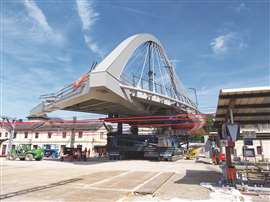 The heavy bridge segment was maneuvered through a confined rail corridor. Category: Rigging $300,000 to $1 million
The project required handling bridge components weighing up to approximately 1,000 tons and measuring nearly 80 metres in length, along with an additional 340 ton segment. All work was performed within an active rail corridor and had to be completed during a tightly controlled closure window.
The limited rail shutdown placed strict constraints on planning and execution. All removal, transport and installation activities had to be completed within a four-day window in February 2025. Any delay would have directly impacted rail operations, making schedule certainty a critical component of the project.
Mobilization required dozens of transport trucks to move specialized lifting and transport equipment from Belgium to Luxembourg. Once onsite, crews faced restricted staging areas within a dense urban environment, requiring careful coordination to assemble equipment without interfering with surrounding infrastructure. One of the most significant challenges was the presence of overhead railway catenary lines, which remained in place throughout the operation. Traditional methods would have required dismantling or modifying these systems, adding time, cost and operational risk.
To address this constraint, Sarens engineered a custom CS250 tilting system, developed specifically for this project. The system dynamically repositioned support points during transport, enabling them to pass safely above the overhead lines without requiring any infrastructure modifications. This eliminated the need for disruptive preparatory work and preserved the integrity of the rail system while maintaining the project schedule.
Bridge sections were transported using self-propelled modular transporters, with synchronized movement critical to maintaining load stability and preventing structural stress. Transport paths were carefully planned to account for limited maneuvering space within the station and surrounding urban area. Every movement required precise coordination between transporter operators to ensure balanced load distribution and controlled travel.
Once positioned, the bridge sections were installed using a combination of SPMT, jacking towers and the custom tilting system. The operation involved removing existing bridge components, positioning the new sections and completing final alignment within tight tolerances. The final segment was placed as one of the last steps before reopening the railway to traffic.
Given the proximity to active rail infrastructure and the scale of the loads involved, safety planning was central to every phase of the project. Transport operations were continuously monitored to ensure synchronization of driving forces across transporter units. Load distribution, structural integrity and system performance were verified throughout each stage.
Close coordination with the project team and rail authorities ensured all activities were executed in accordance with operational and safety requirements. Despite the complexity of the lift and the confined work environment, the project was completed on time and safely.
By combining innovative engineering with precise execution, Sarens delivered a solution that allowed massive bridge components to be transported and installed over active railway infrastructure, demonstrating how specialized systems can overcome constraints that would otherwise limit traditional heavy lift methods.
Deep drop
PSC Crane & Rigging executed the lift, translation and 185-foot (56 metre) vertical lowering of a 1,527,600-pound (693 tonne) tunnel boring machine into a starter shaft in Cleveland, Ohio, delivering a highly engineered solution within a confined urban construction site. The project required precise coordination, advanced engineering and disciplined execution to safely manage one of the heaviest and most complex components in underground construction.
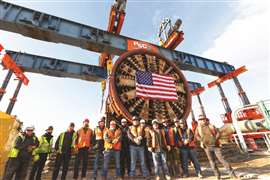 The PSC Crane & Rigging team delivered a complex heavy lift solution that involved lowering a tunnel boring machine. Category: Rigging $1 to $3 million
PSC designed a gantry-based lifting system consisting of dual 190-foot (58 metre) rail tracks installed over engineered timber matting and steel distribution plates. The support system was engineered to maintain ground bearing pressures within allowable limits while supporting the massive, suspended load.
The gantry structure incorporated an eight-point hydraulic configuration, combining a J&R Engineering Lift-N-Lock 900-ton (816 tonne) four-post system with a 700-ton (635 tonne) four-post system. These systems supported a series of heavy gantry beams that created a stable load path throughout the lift, translation and lowering phases.
The project site presented significant limitations, including a restricted footprint, active construction operations and the need to protect surrounding infrastructure.
PSC developed a detailed execution plan that relied on just-in-time delivery of equipment and components. This approach minimized congestion on site and allowed the heavy lift operation to proceed without disrupting adjacent work areas or impacting the overall construction schedule.
At the core of the operation was a synchronized four-point strand jack system, each rated at 5,000 kN. This system provided precise load equalization and controlled movement during the 185-foot descent.
To further improve efficiency, PSC implemented an offsite assembly strategy. All strand jack systems were fully assembled and reeved at the company’s Milford, Ohio facility prior to mobilization.
Each lifting module, including strand jacks, recoilers, strand management systems and hydraulic power units, was delivered to the site as a complete unit ready for installation. This modular approach eliminated the need for approximately 18,000 linear feet of strand laydown on site, significantly reducing the required working area.
It also removed more than 700 labor hours from the field schedule, reduced the risk of contamination and improved overall system reliability. By shifting complex assembly work offsite, PSC was able to streamline installation while maintaining tighter control over quality and performance.
Following system commissioning and a controlled test lift, the team executed the lowering operation using continuous hydraulic monitoring and positional feedback. This ensured load balance was maintained throughout the descent, protecting both the equipment and the surrounding structure as the tunnel boring machine was lowered into position.
The project was completed between March and April 2025. Through a combination of engineered systems, offsite preparation and disciplined execution, PSC Crane & Rigging successfully delivered a complex heavy lift solution within a constrained urban environment, demonstrating precision, efficiency and a strong commitment to safety.
One piece exit
Mammoet Americas executed the removal, transport and offloading of the suspended mid-span of the U.S. 181 Harbor Bridge in Corpus Christi, Texas, delivering a highly engineered solution that eliminated traditional demolition methods and reduced impact to surrounding infrastructure.
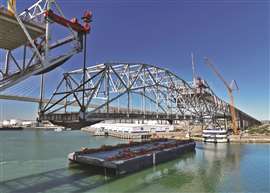 Bridge mid-span suspended by strand jacks during controlled lowering operation. Category: Rigging Over $3 million
The aging truss bridge, which had served the region for more than 60 years, was replaced by a new cable-stayed structure. Mammoet was tasked with removing the central span, a structure weighing approximately 2,300 tons (2,087 tonnes), and transporting it for dismantling.
Several approaches were evaluated during planning, including dismantling the bridge piece by piece or using controlled demolition. Removing the span as a single unit offered clear advantages. It reduced the number of workers operating at height, minimized disruption to nearby facilities including an aquarium, and allowed shipping lanes to reopen more quickly.
Mammoet’s team engineered a custom strand jack system using four 900-ton capacity units mounted on cantilever beams attached to the existing bridge structure. Eight cantilever beams were used in total, including newly fabricated components and modified existing equipment. Detailed inspections and 3D modeling were conducted to identify potential interferences, confirm fit and ensure proper alignment across multiple structural elements.
Due to limited available space, the lifting system required a fully bespoke design, including a custom carrier beam interface connecting the bridge to the strand jacks. Because the bridge’s exact weight was unknown, engineers incorporated a significant safety margin, designing the system to handle up to 3,000 tons.
Before full separation, an initial “eyebrow cut” was performed to create a small opening that allowed the team to lift the span slightly and verify weight, deflection and system behavior. This step ensured stability and confirmed that all clearances were within acceptable limits before proceeding. The span was lowered approximately 40 metres onto a 300-foot-by-100-foot barge positioned beneath the structure.
Barge preparation required precise engineering. The vessel had to be aligned within a three-inch tolerance and stabilized using an expanded mooring system. Initial plans for four mooring points were increased to eight following testing to ensure adequate holding capacity.
Load testing was performed on all winches used for mooring, and additional adjustments were made to account for real-world conditions during the operation. During lowering, the bridge exhibited greater flexibility than anticipated, resulting in uneven load distribution across the barge supports. To address this, additional shimming was installed, and the span was brought into contact with self-propelled modular transporters positioned on the barge. Using their onboard stroke, the SPMTs acted as supplemental supports, improving stability during transport.
After lowering, the span was transported via barge to the Inner Harbor Cargo Dock, where it was offloaded onto SPMT configured with 108 axle lines. The structure was then moved to a designated area for dismantling.
The critical phase of the operation was constrained by a 36-hour window to position the barge, lower the span and clear the channel for reopening to marine traffic. Despite a two-day weather delay, the team completed the operation within the scheduled timeframe.
The project included nearly 2,000 engineering hours. By removing the bridge span in a single piece, Mammoet reduced risk, improved efficiency and minimized disruption, demonstrating how engineered lifting solutions can transform complex demolition projects into controlled, predictable operations.
A routing conundrum
Buchanan Hauling & Rigging executed the transport of a stainless steel milk processing tank measuring more than 100 feet (30 metres) in length, across a 290 mile (470 km) route through challenging terrain and restrictive infrastructure. Despite its relatively light weight of 52,000 pounds, the load’s extreme dimensions created significant logistical challenges, particularly related to height and clearance limitations.
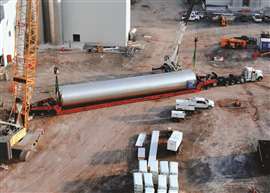 Milk processing tank mounted on perimeter frame trailer with minimal clearance to support beams. Category: Hauling Less than 260,000 pounds (gross)
Routing proved to be one of the most complex aspects of the project. The height of the load eliminated many potential routes, forcing the team to develop a circuitous path through hilly terrain, incorporating 25 turns and multiple multi-lane roundabouts. Frequent stops and route constraints effectively doubled the expected travel time. Each turn required manual steering due to the length of the trailer, while elevation changes demanded precise control to prevent the load from bottoming out.
To manage grade transitions, operators utilized the stroke of the trailer to maintain clearance, particularly in the early stages of the route where terrain was most severe.
The trailer configuration was critical to the success of the move. The load was mounted on a 60-ton modular perimeter frame trailer, pulled by a four-axle tractor, with the entire system engineered to maintain a perfectly level profile.
Clearances were extremely tight, with only three-quarters of an inch between the tank and supporting cross members. Because the load was supported only at the ends, more than 90 feet (27 metres) of the trailer carried no weight, creating stability concerns across the span. To address this, Buchanan’s team implemented a custom stabilization system using half-inch airline cable arranged in an X-pattern along the trailer. This prevented lateral movement while avoiding interference with structural cross members.
Before stabilization, the unsupported portion of the trailer could shift significantly under minimal pressure. Once installed, the cable system provided the rigidity required to safely transport the load within such tight tolerances. Additional constraints eliminated traditional cushioning methods, requiring the team to rely on precise leveling and engineered stabilization to protect the cargo.
The project involved 28 separate loads over a multi-month period, with peak operations involving two trailers moving simultaneously. Co-ordination with the New York State Department of Transportation and state police was critical throughout execution. Law enforcement support helped streamline movement and reduce overall project duration, while maintaining strict safety oversight across all phases.
In total, the project required approximately 400 hours of preparatory work, including engineering, route surveys and coordination with local municipalities, followed by 3,000 personnel hours during execution.
The transport was completed between March 14 and August 27, 2025. Through detailed planning, innovative stabilization techniques and precise execution, Buchanan successfully delivered a highly sensitive oversized load through a route where less than an inch of clearance dictated every decision.
Blade haul
Bragg Companies executed the transport of 250 wind turbine components, including 75 of the largest windmill blades in California, from the Port of Stockton to a wind farm site in Hollister, followed by complex onsite delivery to individual turbine pads. The project was carried out across four coordinated phases: port operations, over-the-road hauling, onsite transport and final erection support.
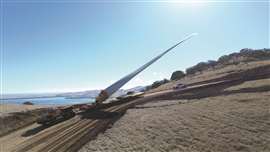 A Goldhofer FTV850 and ADDrive system navigated a steep dirt road within wind farm site. Category: Hauling 260,000 - 360,000 pounds (gross)
All components were received at the Port of Stockton and staged in a secured 16-acre yard before being configured for line-haul transport. From there, loads were moved approximately 91.8 miles (150 km) to the project site using engineered trailer configurations designed to accommodate axle loads, bridge restrictions and route clearances.
Each blade measured 237 feet 6 inches long and weighed 47,399 pounds, with gross transport weights reaching 134,700 pounds. Over the course of the project, blade transports alone totaled more than 3.5 million pounds across nearly 6,900 miles.
The port-to-site operation required more than 11,000 manhours, along with detailed permitting, route analysis and coordination with state and local agencies, including the California Highway Patrol. Onsite transport presented significantly greater complexity. Located within a California State Park, the wind farm featured narrow, unimproved roads, protected vegetation and strict limitations on civil modifications.
Routes included grades of up to 17 per cent, tight turning radii and clearance constraints beneath overhead lines, all while operating in congested conditions alongside active construction and public access roads. To move blades from the staging yard to individual turbine pads, Bragg deployed Goldhofer FTV850 transporters combined with ADDrive systems — marking the first time this configuration was used in this type of application.
This approach allowed operators to navigate steep grades and restricted terrain without additional push or pull trucks, reducing both environmental impact and operational complexity. Each turbine location presented limited laydown space and restricted crane working areas, requiring deliveries to be tightly sequenced with erection operations. Components were delivered just-in-time to maintain installation schedules and avoid congestion across the site.
Onsite transport operations accounted for more than 20,000 manhours, supported by extensive coordination with project stakeholders, including Scout Clean Energy, Clark Bros., Inc., California State Parks and environmental agencies. Safety planning addressed a wide range of risks, including high winds along the ridgeline, wildfire exposure, limited maneuvering space and environmentally sensitive operating zones.
For highway transport, Bragg developed a customized blade configuration that elevated the blade tip to clear overhead obstacles without requiring infrastructure modifications. This reduced project costs and minimized disruption along the route. Onsite, the integration of advanced transport systems and precise operational planning allowed the team to navigate extreme terrain and tight constraints without significant civil work or delays.
Through a combination of engineering, coordination and innovative transport solutions, Bragg Companies successfully delivered oversized wind components across both public infrastructure and highly constrained terrain, supporting efficient installation of a major wind energy project.
Million pound run
Barnhart transported an LP turbine and generator from the Port of Duluth, Minnesota, to a power plant site in Wolverine, Saskatchewan, moving two oversized loads with combined gross weights approaching 1 million pounds. The turbine, weighing 403,442 pounds, was hauled on a 20-line GS-800 trailer configuration, while the generator, weighing 345,133 pounds, traveled on a 13-line setup.
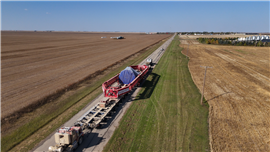 Barnhart’s GS-800 trailer transporting LP turbine through mountainous terrain with full roadway control. Category: Hauling Greater than 360,000 pounds (gross)
Originally planned routing through North Dakota was eliminated due to seasonal weight restrictions, forcing a significant detour south through South Dakota, west across Montana and then north into Saskatchewan. This revised route extended the haul to approximately 1,900 miles, introducing mountainous terrain, severe grades and increased permitting complexity across multiple jurisdictions.
The project began with a demanding night-time departure from Duluth, navigating tight city streets, 22 traffic signals and a low-clearance bridge with only inches to spare. To pass beneath the bridge, the load was lowered nearly to the pavement using engineered trailer adjustments, avoiding a more disruptive reroute through residential areas.
Throughout the journey, additional coordination included approvals from seven rail districts, multiple municipalities and more than 40 utility companies to schedule line lifts and secure clearance windows. In Montana, extended grades of up to 9 percent placed sustained stress on transport equipment. Mechanical issues involving radiators, drivelines and rear ends required continuous maintenance and rapid response.
To maintain schedule, Barnhart deployed spare trucks, arranged local equipment support and utilized onboard mechanics to perform repairs and tire changes in real time, ensuring zero lost travel days. Narrow rural roads often required full roadway occupation, with rolling roadblocks and advance escort teams managing traffic, including backing vehicles off the route to allow safe passage.
The GS-800 trailer’s hydraulic lifting capability was critical throughout the project, allowing operators to raise or lower loads as needed to navigate obstacles including rail crossings, roundabouts, ditches and curbs.
Near the final destination, a steep unpaved hill presented traction challenges, prompting coordination with a local farming community to provide tractors for assisted pulling, ensuring safe completion of the final approach. Late cargo arrival compressed the delivery schedule to just 18 days before liquidated damages would be triggered.
Despite this constraint, Barnhart completed delivery in 16 days, arriving ahead of schedule with no downtime. The full project, including mobilization and demobilization, ran from August 25 to October 3, 2025.
With extensive planning, cross-border coordination and adaptive execution under extreme conditions, Barnhart successfully delivered critical power generation components across a highly complex route – on time, without incident and under significant logistical pressure.
Shiplift shenanigan
Berard Transportation completed the transport and installation of a 25,000-ton capacity shiplift, delivered in 27 individual sections and assembled with precise sequencing at a shipyard facility. The project included 14 rigid sections and 13 articulating sections, with total installed weight reaching 4,538 metric tons. Each component required exact placement, with final tolerances of just one-quarter inch.
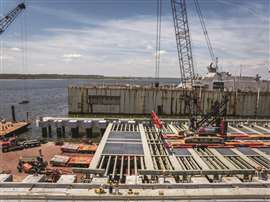 The shiplift section was transported by SPMT to the barge loadout point. Category: Moving
Execution was divided between land-based and marine-based operations that had to occur simultaneously. Rigid sections were transported approximately 1,000 feet over land using self-propelled modular transporters to a bulkhead, where they were loaded onto a 260-foot by 72-foot deck barge. The barge then carried the sections approximately 2,000 feet across the water to the piers, where they were installed using a combination of barge positioning and SPMT support.
At the same time, articulating sections were transported over land to a crawler crane positioned on previously installed sections. The crane lifted and held each section in place while rigid sections were installed, requiring precise synchronization between crews. Installation windows were dictated by tidal conditions, with all placement operations required to occur at low tide due to clearance restrictions. This required exact coordination between marine crews, land crews and crane operations to ensure each sequence aligned with limited working windows.
Barge teams developed detailed ballast plans to achieve the correct freeboard at specific tide levels, ensuring proper alignment during installation. The project took place within an active shipyard environment, requiring coordination around ongoing operations and the presence of sensitive equipment, including Navy assets.
Transport routes included uneven ground and a downward grade toward the barge, while installation areas were confined with minimal clearance. In some locations, crews worked with just over seven inches of space, while maintaining strict placement tolerances.
Limited mooring points at the piers required additional engineering solutions, including the use of winch trucks, weld-on deck winches and a spud barge to secure positioning during installation. The articulating sections, weighing up to 113 metric tons, were lifted using a 275-ton crawler crane. Due to load limitations on the installed structure, Berard engineered a load-spreading plan incorporating mats and support systems to safely distribute crane loads across temporary support beams.
This ensured the crane could operate safely while positioned directly on partially completed sections. The project was completed between March 27 and April 16, 2025, with all sections installed safely and within required tolerances.
Through detailed planning, synchronized operations and engineered load management, Berard successfully delivered a complex installation requiring constant coordination between land and marine teams in a constrained and active environment. The project was completed seven days ahead of schedule.
“This project pulled together everything I’ve learned over my career, and I’ve spent my entire life in this industry,” said COO Braedon Berard. “I couldn’t be prouder of this team and the way they executed, especially given the challenges we were dealt.”