How robotics are shaping the access sector

06 July 2026
For decades the MEWP sector has focused on making work at height safer, more efficient and more productive. This remains the case but with advances in robotics and artificial intelligence, manufacturers are looking to take the next leap forward with intelligent robotic lifts capable of carrying out increasingly complex tasks with minimal human intervention.
Whether through robotic arms, autonomous navigation, AI-powered operating systems or robots working alongside people, the industry is beginning to redefine the role of access equipment on the modern jobsite.
While fully autonomous construction sites remain some way off, developments unveiled over the past year demonstrate that robotics is moving from R&D to real-world applications.
Designing the future
Among the companies pushing this technology is JLG, which used ConExpo to demonstrate what it described as the ‘jobsite of the future.’
 The welding end effector prepares to weld the steel beam.
Rather than showcasing a single autonomous machine, JLG presented an ecosystem in which multiple pieces of equipment communicate and work together. In the demonstration, a pair of autonomous scissor lifts transported a steel beam using leader-follower technology before positioning it for installation. A boom lift fitted with a robotic welding end-effector then completed the welding operation while the human operator remained safely on the ground.
For JLG’s parent company Oshkosh, the concept represents a significant shift in how work at height could eventually be carried out.
“To do this, you need to process data and images very quickly, and you can’t do that with local computing,” explains Mahesh Narang, president of JLG. “You have to send it to a data centre to compute it and send it back.”
The company believes cloud computing, machine vision and connected equipment will underpin the next generation of autonomous construction equipment.
“There will be more and more moments of autonomy that will be launched in the world,” Narang said. “And that’s the future of our products too – executing jobs through connecting a product to other connecting ecosystems.”
Perhaps the most compelling aspect of these developments is its safety implication.
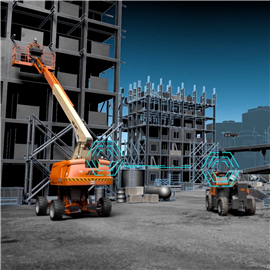
“The safest place for an operator is on the ground,” Narang added. “So now we want the operator to be on the ground and let the boom weld it at 60 feet.”
However, it will take time for the technology to breakthrough onto the worksite. JLG sees automation arriving incrementally with leader-follower systems nearing commercial readiness, while more advanced robotic applications such as automated welding remain further away.
“It won’t be like we suddenly have a revolutionary product in five years’ time,” Narang explained. “Everything you see will be launched in phases over the next few months and years.”
That phased approach is already evident following JLG’s acquisition of construction robotics specialist Canvas Robotics. The autonomous drywall sanding robot, which is a result of the deal, is expected to begin generating revenues this year, demonstrating how robotic technologies developed outside traditional access equipment can be integrated into the sector.
Assisting rather than replacing operators
While robotics often raises concerns about replacing human labour, manufacturers are largely positioning their developments as tools that complement skilled workers rather than eliminate them.
Genie’s latest concept illustrates this philosophy.
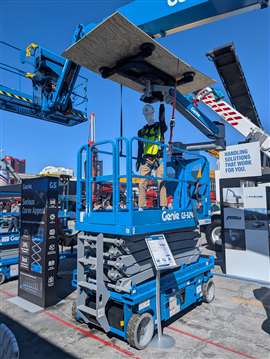 Genie’s assistive material handling device.
Displayed at ConExpo, the company’s assistive material handling device uses robotic actuators and vacuum technology to support heavy materials such as drywall panels inside a scissor lift basket. Rather than functioning as a fully autonomous robotic arm, the system allows operators to guide heavy loads effortlessly while the technology compensates for the weight.
As Ryan Crow, Genie vice president of global product management, explains, “Drywall panels are very
heavy, so we have vacuum end effector that can suck onto the panel and allow you to effortlessly move it into position and hold it there.”
The technology enables workers to install materials without physically supporting their weight, improving ergonomics while potentially increasing installation speed.
Crow believes innovations like this could fundamentally change work at height over the next decade.
“There will be a point where you’re going to see more automation at height,” he said. “And this is the type of technology that would make that possible in the future.”
Importantly, Crow argues that the greatest challenges are no longer technological.
“It’s not a technology issue when it comes to speed of adoption,” he said. “It’s how does it fit into the workflow on a job site? What is the willingness of adoption – is it supporting jobs or replacing them?”
“Our goal is to improve the productivity of work done by people using our equipment.”
Robotic arms in action
Haulotte is exploring a similar path through partnerships with specialist robotics companies.
Its collaboration with French deep-tech company Builder Assist centres on Surface Assist, a robotic arm designed specifically for complex construction applications while mounted on MEWPs.
Unlike conventional access equipment, the robotic arm performs physically demanding repetitive tasks such as overhead drilling, facade painting and coating operations, reducing worker fatigue while maintaining precision.
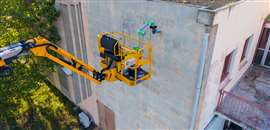 Haulotte has partnered with Builder Assist to create the Surface Assist robotic arm. (Image: Haulotte).
Pilot machines are already being evaluated on active construction sites to determine both customer demand and operational performance.
Builder Assist Chief Executive Alban Brisy believes construction provides the ideal environment for robotics.
“A construction robot only makes sense if it operates where work is most demanding and exposed,” he said. “We are delighted to collaborate with Haulotte to combine working-at-height expertise with robotics innovation, serving real construction use cases.”
For Haulotte, the project forms part of a broader innovation strategy that seeks to expand the role of aerial platforms beyond simple access.
“Embedded robotics opens up new perspectives for working at height applications,” said Philippe Luminet, innovation director at Haulotte. “With Builder Assist, we are exploring solutions that can deliver tangible value on jobsites, by combining access expertise, automation and a deep understanding of field operations.”
The company is further demonstrating this philosophy through its latest collaboration with AMBPR, developing robotic cleaning, blasting and painting systems for naval and industrial applications.
Beyond the jobsite
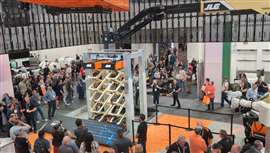
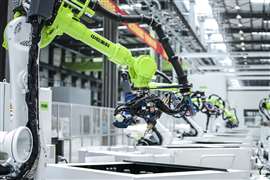 According to Zoomlion, the Smart Factory is not an automation project, but a full digital transformation
The influence of robotics is not confined to how aerial platforms are used. It is increasingly shaping how they are manufactured.
Chinese construction equipment giant Zoomlion has rapidly emerged as an ambitious adopter of embodied intelligence. Its AI-enabled Smart City manufacturing complex in Changsha integrates 12 smart factories and more than 300 production lines.
According to the company, the facility can now produce an excavator every six minutes, a scissor lift every 7.5 minutes, a truck crane every 18 minutes and a concrete pump every 27 minutes.
Dozens of humanoid robots now undertake loading, unloading, assembly support and quality inspection throughout the factories.
Rather than treating robotics as isolated automation projects, Zoomlion has made AI a central pillar of its corporate strategy, integrating it across product development, manufacturing, management and robotic systems.
The company describes embodied intelligence as its “third growth curve,” supported by dedicated robotics training facilities featuring more than 100 workstations that continuously generate operational data to improve robot performance.
And, Zoomlion’s ambitions extend beyond manufacturing. Earlier this year the company unveiled Robot Ops, a unified operating system designed to provide a common AI platform across construction equipment, industrial robots, autonomous vehicles and humanoid robots.
The significance lies not simply in making individual machines more intelligent, but enabling multiple autonomous machines to communicate, learn and collaborate.
Robot Ops incorporates imitation learning, reinforcement learning and task orchestration, allowing machines to observe human operators, improve through experience and coordinate complex activities together.
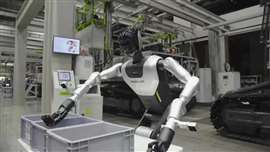 A Zoomlion humanoid robot performs sorting tasks on the factory floor (Image courtesy of Zoomlion)
In practice, this could eventually see autonomous excavators, dumpers, cranes and aerial platforms working together on construction projects with minimal human supervision.
Zoomlion says the platform “directly addresses four key industry challenges: high technical barriers, scenario migration difficulty, data bottlenecks, and lack of lifecycle management.”
Although applying this technology to construction sites remains a considerable challenge, the development demonstrates how rapidly major OEMs are investing in AI that will play a vital role in future autonomous fleets.
New markets for robotics
The versatility of robotic mobility platforms is also creating opportunities outside traditional construction.
Haulotte’s recent industrial partnership with Ukrainian Unmanned Technologies illustrates how expertise developed within access equipment manufacturing can support robotic ground vehicles.
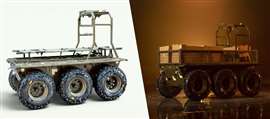
The collaboration will industrialise production of UUT’s electric six-wheel-drive RAVLYK robotic logistics platform, designed for logistics, casualty evacuation, reconnaissance and hazardous operations.
Although initially focused on defence applications, both companies acknowledge significant long-term potential in civil emergency response, disaster recovery and hazardous industrial environments where removing personnel from dangerous situations offers obvious safety benefits.
Taken together, these developments reveal an industry moving steadily towards greater automation rather than pursuing fully autonomous construction overnight.
Instead of replacing operators, the first generation of robotic aerial platforms is likely to support them through material handling assistance, repetitive task automation, autonomous positioning and precision operations that improve safety and productivity.
In addition, manufacturers are aligned in how they see the future. Connected machines, AI-assisted decision making and robotic end-effectors are all expected to arrive progressively over the coming years.
As cloud connectivity and machine learning systems improve, aerial platforms are becoming increasingly intelligent rather than simply mobile access machines.
The transition will undoubtedly take time, influenced as much by industry acceptance, regulation and jobsite practices as by engineering capability.
However, for an industry whose core purpose has always been getting people safely to work at height, the next chapter looks set to increasingly involve keeping operators safely on the ground while intelligent machines perform the task above.